
This website uses cookies so that we can provide you with the best user experience possible. Cookie information is stored in your browser and performs functions such as recognising you when you return to our website and helping our team to understand which sections of the website you find most interesting and useful.
News
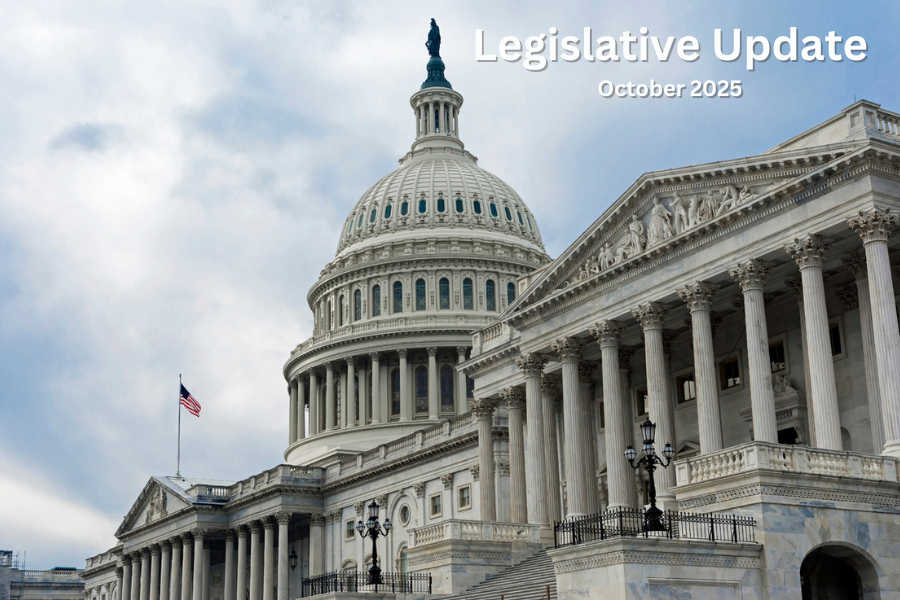
Legislative Update: Political Brinkmanship Deepens as Shutdown Nears One Month
Political Brinkmanship Deepens as Shutdown Nears One Month
The government shutdown, now nearing a full month, shows little sign of resolution as negotiations remain stalled and President Donald Trump’s absence abroad limits direct engagement with congressional leaders. Democrats maintain that any meaningful deal to reopen the government depends on the president’s approval, while Republicans insist that a solution must emerge organically from rank-and-file negotiations. Both sides remain entrenched, with lawmakers largely resigned to a continuation of the impasse unless a significant crisis shifts the political calculus before the month’s end.
Several mounting deadlines in early November could, however, force action. The first is the growing financial toll on federal employees — more than 650,000 workers missed paychecks last week, and all branches of the military are expected to do so by Friday. The administration may attempt to redirect funds to cover active-duty pay, but such measures are limited and legally complex. Meanwhile, Senate discussions over a legislative remedy for federal pay have stalled, compounding frustration among both parties as the real-world effects of the shutdown deepen.
Equally concerning is the risk to the Supplemental Nutrition Assistance Program (SNAP), which faces potential funding lapses beginning November 1. At the same time, Democrats may seek to leverage the upcoming November 1 deadline for the Affordable Care Act’s open enrollment period, which coincides with expected premium increases due to the expiration of enhanced subsidies. Upcoming elections in California, New Jersey, and Virginia on November 4 could further influence this calculus: decisive Democratic wins might bolster the party’s messaging that its stance on healthcare and the shutdown resonates with voters. However, should Democrats emerge strengthened, they may instead harden their resolve to prolong the standoff, believing continued pressure will yield greater political dividends — while Republicans, convinced they are also winning, remain equally unwilling to compromise.
Permitting Legislation Advancing Quietly Amid Shutdown Disruptions
Senate Environment and Public Works (EPW) Committee Chairman Shelley Moore Capito (R-WV) and Senate Energy and Natural Resources Committee Chairman Mike Lee (R-UT) continue to emphasize that reforming the National Environmental Policy Act (NEPA) and modernizing federal permitting processes remain top Republican priorities. Senators on both sides of the aisle are engaged in discussions on permitting reform as committee staff work behind closed doors on feedback from stakeholders. EPW Ranking Member Sheldon Whitehouse (D-RI) indicated that the committees’ Republican and Democratic leadership are aiming to release “a framework” for a “large, balanced package” by the end of this year. Whitehouse said this framework will give Senators clear direction that they can later refine into formal legislative text.
There has still been no indication that the Senate Committees are planning to introduce a companion bill to the SPEED Act, or whether similar proposals will be included in the package. Whitehouse’s remarks marked a shift in tone, as only a week earlier, the Senator had warned that the Trump administration’s actions against clean energy projects were jeopardizing bipartisan cooperation. Despite maintaining those concerns, he conveyed renewed optimism about reaching consensus on a comprehensive permitting reform proposal while echoing Capito’s goal of winning backing from 15 to 20 Democrats.
The House is out of session for a fourth week. The House Natural Resources Committee’s staff continues to work privately on legislative language for a larger permitting reform package that will go beyond just NEPA reform, and members and. staff are holding internal discussions to reconcile policy approaches. Chairman Bruce Westerman (R-AR) has not yet expressed any support for additional proposals beyond the initial SPEED Act.
Meanwhile, organizations continue to plan their lobbying campaigns to try to influence lawmakers to move permitting reform forward. The National Association of Manufacturers (NAM) released a report urging Congress to accelerate permitting reform to enable faster deployment of AI technologies and energy projects central to President Donald Trump’s “energy dominance” agenda. NAM wields considerable influence among its members, especially Republicans. Dozens of governors wrote a letter to the leadership of key committees calling for streamlined approval processes for energy and infrastructure projects. The American Petroleum Institute has also launched a seven-figure ad buy pushing lawmakers to pass comprehensive permitting reform.
Lawmakers Push to Streamline LNG Permitting as the Administration Clears a Major LNG Facility in LA
The Department of Energy (DOE) has granted final authorization for the Calcasieu Pass 2 LNG facility in Cameron Parish, Louisiana, marking another major step in the Trump administration’s push to expand U.S. energy exports. Assistant Secretary for Fossil Energy Kyle Haustveit said the approval reflects President Donald Trump’s goal of “unleashing American energy,” while providing energy security for U.S. allies and creating domestic jobs. The project, which sits adjacent to the original Calcasieu Pass terminal, has been delayed since early 2024 due to the Biden administration’s pause on LNG export approvals. Energy Secretary Chris Wright has set an ambitious goal of doubling U.S. LNG exports by the end of Trump’s term, reinforcing the nation’s position as the world’s largest LNG exporter.
Meanwhile, Sen. Ted Cruz (R-TX) introduced the Natural Gas Export Expansion Act (S. 3035), a bill designed to streamline federal permitting and accelerate LNG exports. Co-sponsored by Sens. Kevin Cramer (R-ND) and Shelley Moore Capito (R-WV), the legislation would amend the Natural Gas Act to automatically approve LNG exports not only to countries with free trade agreements but also to non-FTA nations, except those under U.S. sanctions. Rep. Michael Cloud (R-TX) plans to introduce companion legislation in the House, underscoring broad Republican support for the policy as a means to promote energy independence, enhance trade, and solidify America’s position as the world’s leading LNG exporter.
EPW Advances Key EPA Nominations, Passes Save Our Seas 2.0 and Plastics Reuse Bills
On October 29, the Senate Environment and Public Works Committee (EPW) voted (10-9) to favorably approve the nominations of Jeffrey Hall to lead EPA’s enforcement office and Douglas Troutman to head the agency’s chemicals office. The nominations will now go to the full Senate, where they will vote on whether to confirm the nominees.
The Senate committee advanced several environmental measures, including the Save Our Seas 2.0 Marine Debris Infrastructure Programs Reauthorization Act (S. 3022), which would reauthorize federal grant programs through 2030 to reduce marine debris, especially ocean plastics. Initially enacted in 2020, the program was spearheaded by Sen. Dan Sullivan (R-AK) and co-sponsored by Sen. Sheldon Whitehouse (D-RI).
The committee also advanced S. 2110, sponsored by Sen. Jeff Merkley (D-OR), directing the EPA to study the feasibility of plastic reuse and refill systems across economic sectors.
Industry Pressure Mounts as Senate Weighs Next Steps in TSCA Modernization
Senators on the EPW Committee signaled cautious bipartisan interest in exploring targeted reforms to the Toxic Substances Control Act (TSCA) during an October 23 hearing focused on chemical safety and PFAS exposure. Subcommittee Chair Sen. John Curtis (R-UT) and Ranking Member Sen. Jeff Merkley (D-OR) expressed a willingness to collaborate on addressing consumer exposure to PFAS and other harmful substances, though both acknowledged the complexity of regulating chemicals with essential uses in medical and industrial applications. Their exchange stood in contrast to the more partisan tone in the House, where recent discussions on chemical regulation have been marked by mutual recrimination. Despite the encouraging tone, the likelihood of substantial legislative progress remains limited amid ongoing partisan divisions and broader political distractions.
Industry representatives have been urging Congress to revisit TSCA since the 2024 elections, emphasizing the need to reauthorize EPA’s user-fee authority by 2026 and address delays in new chemical approvals. Business leaders, including Peter Huntsman of Huntsman Corp. and Boeing’s Gwen Gross, testified that EPA’s slow pre-market review process is stifling innovation and product development. Chair Sen. Shelley Moore Capito has identified TSCA reform as a priority, but Democrats remain wary of reopening the statute under a Republican-led administration.
Sen. Merkley outlined his priorities for any potential TSCA updates, emphasizing stronger protections against harmful chemicals found in everyday consumer goods, such as cookware, upholstery, and clothing. He criticized the Trump administration’s reluctance to expand staffing for EPA’s chemical review divisions, arguing that the agency’s limited capacity prevents timely and thorough assessments of new chemicals. Republicans, however, questioned whether funding or management priorities were the true bottleneck, noting that appropriations had been provided but positions remained unfilled.
Despite the differing views on EPA staffing and regulatory approach, both Curtis and Merkley underscored a shared commitment to maintaining public safety while ensuring scientific precision in chemical policy. Curtis stressed the need for a nuanced approach to PFAS regulation, citing their irreplaceable role in certain medical devices, while acknowledging consensus on the need to eliminate harmful variants. Both senators expressed optimism about continued bipartisan dialogue, though Curtis declined to predict the scope or timing of any new legislation, saying it was “too soon to say” whether Congress could act before EPA’s TSCA fee authority expires in late 2026.