This website uses cookies so that we can provide you with the best user experience possible. Cookie information is stored in your browser and performs functions such as recognising you when you return to our website and helping our team to understand which sections of the website you find most interesting and useful.

News
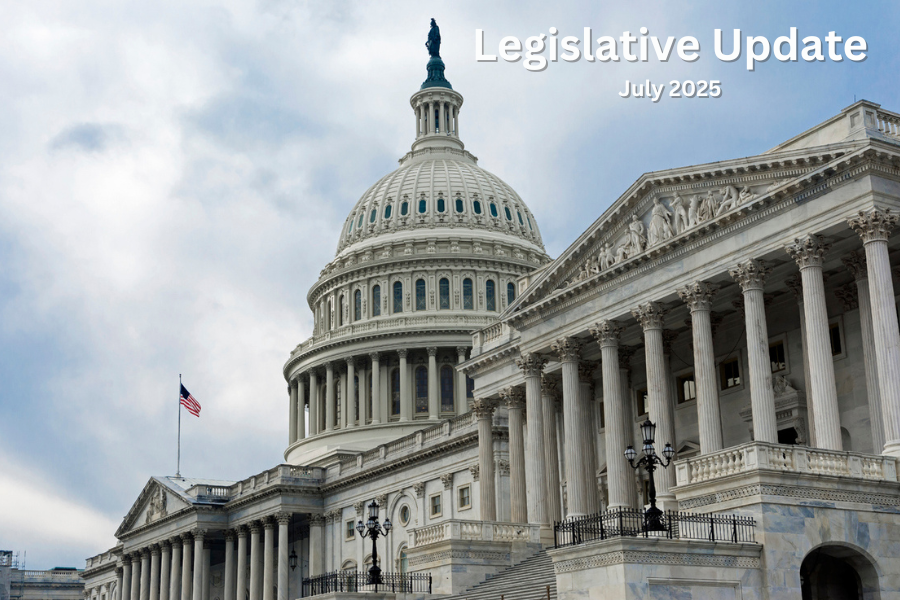
Legislative Update: Trump Signs Sweeping Tax and Policy Bill on July Fourth
Trump Signs Sweeping Tax and Policy Bill on July Fourth
President Donald Trump signed into law a sweeping 940-page domestic policy and tax package (H.R. 1) on July 4, marking a major legislative victory timed with the national holiday. Dubbed the “one big beautiful bill,” the $4.5 trillion legislation encompasses most of the major legislative priorities Trump set for his second term, including substantial tax cuts, deep spending reductions, and record-setting investments in border security. Speaking from the Truman Balcony during a Fourth of July event for military families, Trump emphasized the unprecedented scope of the legislation and credited Vice President JD Vance and congressional leaders for their roles in securing its passage. He described the bill as a catalyst for economic growth and a historic consolidation of Republican priorities. Following his remarks, Trump ceremonially signed the legislation on the South Lawn surrounded by GOP lawmakers.
Republican leadership manifested their ambitious July 4 target by first passing it in the Senate on July 1 after Vice President JD Vance broke a tie. Following extensive negotiations and late-night lobbying efforts led by House Speaker Mike Johnson (R-LA), House Republicans narrowly passed the bill by a vote of 218-214. Reps. Brian Fitzpatrick (R-PA) and Thomas Massie (R-KY) were the only GOP members to break ranks and oppose the measure alongside all Democrats. Johnson secured backing from conservative holdouts by promising future deficit-reduction efforts and the potential for a second reconciliation bill later this year.
President Trump and Vice President JD Vance were deeply involved in swaying undecided members, with direct outreach calls and policy negotiations. The razor-thin victory handed Johnson a significant win and advanced Trump’s top domestic legislative priority.
The Vinyl Institute joined more than 300 organizations led by the National Association of Manufacturers (NAM), in sending a letter to Senate Majority Leader John Thune and House Speaker Mike Johnson advocating for swift passage of H.R. 1, which permanently extends pro-growth provisions from the Tax Cuts and Jobs Act (TCJA) that were initially set to expire at the end of 2025, while introducing a series of temporary and new tax benefits. The letter emphasized that the legislation would foster domestic manufacturing, provide tax certainty, and strengthen the U.S. manufacturing base.
For individuals and families, the bill enshrines into law the TCJA’s lower marginal tax rates, expanded standard deduction, increased estate and gift tax exemptions, and the doubled child tax credit. It also preserves the cap on state and local tax (SALT) deductions, albeit at a temporarily higher level than the TCJA originally allowed.
For businesses, the legislation makes permanent the deduction for qualified pass-through income and expands its scope. It also extends full and immediate expensing of qualified business property and maintains the TCJA’s treatment of research and experimentation expense deductions. The bill introduces temporary tax relief for workers, including breaks on tips, overtime, and car loan interest, and excludes employer contributions to student loan payments from taxable income.
The fossil fuel industry is also celebrating the bill’s passage, which delivers a tax break estimated to be worth more than $1 billion for oil and gas producers while rolling back many of Biden and prior Congress’s subsidies for industries like wind and solar. . Industry groups such as the American Petroleum Institute and the Western Energy Alliance praised the legislation for expanding leasing, promoting infrastructure development, and extending favorable tax treatments for fossil fuel production.
What’s Next on the Legislative Agenda?
Now that Congress has passed the OBBB, Republican leadership faces a packed legislative agenda with several high-stakes and must-pass items. With Congress set to recess in August, the House has only 21 legislative days remaining before the September 30 deadline to fund the federal government for FY2026. Progress has been minimal, and growing pressure is fueling serious concerns about a potential government shutdown.
To date, only one appropriations bill has cleared the House, while the Senate has yet to advance any. Although the Senate Appropriations Subcommittees have begun marking up some appropriations measures this week, the process has already encountered delays and political tensions. At least one continuing resolution (CR), and possibly more, now appear inevitable. However, bipartisan agreement remains elusive, particularly as the White House insists on $163 billion in non-defense discretionary spending cuts—proposals that congressional Democrats strongly oppose.
Tensions have intensified further as Republicans push a $9 billion rescissions package that includes cuts to NPR and USAID foreign assistance programs. Senate Majority Leader Chuck Schumer (D-NY) has warned that such proposals could derail negotiations. Speaker Mike Johnson (R-LA) is attempting to align FY2026 spending with President Donald Trump’s proposed budget levels, but acknowledged that the figures are still being finalized. Meanwhile, the Senate Appropriations Committee is lagging and remains divided over topline funding levels.
The broader political climate adds to the uncertainty. Schumer’s support for a March CR drew backlash from within his party, making him less likely to agree to another temporary extension without concessions. Even if Johnson can secure House passage of a GOP-only CR, Senate Republicans will still need some Democratic votes—a scenario that remains uncertain without acceptable trade-offs.
Despite these challenges, a government shutdown is not inevitable. Congress has a long history of reaching eleventh-hour agreements to avoid funding lapses. Democrats, who have consistently opposed shutdowns due to their economic and political consequences, may ultimately support a clean CR. However, the outcome may hinge on the extent of President Trump’s influence and Democrats’ willingness to negotiate under politically adverse conditions, especially given Trump’s prior openness to using shutdowns as leverage.
In addition to appropriations, Republican leaders must also navigate several other critical legislative priorities. The Senate continues its effort to confirm numerous Trump administration nominees to key federal positions. The $9 billion GOP rescissions package must be enacted by July 18. Both chambers are also beginning work on the annual National Defense Authorization Act (NDAA). Meanwhile, severe flash flooding in Texas has prompted discussions of a supplemental disaster relief bill, which lawmakers note may need to include aid for other states facing recent natural disasters.
And to top it all, House Speaker Mike Johnson (R-LA) is floating an ambitious Republican plan to pursue two additional reconciliation packages over the next year. Speaking shortly after Congress passed President Donald Trump’s signature legislation, Johnson indicated that Republicans intend to replicate the strategy. He stated that the next reconciliation package would be introduced in the fall, followed by a third in the spring of next year.
U.S. Opposes Plastic Production Limits in UN Treaty Negotiations
At the informal UN plastics treaty talks held in Nairobi, the U.S. publicly opposed including limits on plastic production in the upcoming global agreement, marking a significant shift from the Biden administration’s position. The U.S. delegation stated that decisions on plastic and feedstock production should remain under national jurisdiction rather than be regulated through global mandates.. The shift comes after months of ambiguity under the Trump administration, which had not clearly articulated its stance during prior negotiations in Busan, South Korea.
The Nairobi meeting was viewed as a pivotal moment to prepare for the final round of treaty negotiations (INC-5.2) scheduled for August in Geneva. While some progress was made on general treaty language, negotiators reported persistent divisions over the core issue of production controls. A coalition of nearly 100 countries, representing both developed and developing nations, supports binding targets to reduce global plastic production and consumption. Conversely, petrochemical-producing nations argue that the treaty should focus solely on managing consumption and improving recycling infrastructure.
Some members of the “high-ambition coalition” suggested that a compromise might involve transparency requirements rather than hard caps on production. A proposal from Japan took that direction, calling for international cooperation on sustainable production and mandatory reporting of supply chain data.
Uncertainty remains over the role the U.S. will play in the final negotiations in Geneva. Negotiators are now recalibrating strategies in anticipation of next month’s talks, where the U.S.’s decision to support even moderate production-related provisions may heavily influence the outcome of the global plastics treaty.
Administration Reverses Plan to Weaken Asbestos Ban
The Trump administration reversed its earlier plan to weaken the Biden-era ban on chrysotile asbestos, following strong opposition from public health advocates and environmental groups. The Environmental Protection Agency (EPA) announced in a court filing that it would no longer pursue a new rulemaking process to rewrite the ban, and instead will defend the existing prohibition. This marks a shift from the agency’s previous position, when it indicated that certain aspects of the 2024 rule may have gone too far and floated alternative approaches, such as enhanced workplace protections, rather than a full ban.
The Biden administration implemented the ban under the authority of the reformed Toxic Substances Control Act, citing decades of insufficient regulatory action. Industry groups have challenged the rule in court, while the Asbestos Disease Awareness Organization has argued that the ban should be even stricter and opposed any delay in its implementation.
EPA officials now claim that the Biden-era rule did not sufficiently address health risks for workers, but they have opted against pursuing a lengthy 30-month rewrite. Instead, they indicated a narrower focus on reviewing workplace protections during gasket replacement procedures.
Trump Delays Tariff Hike as U.S. Nears New Trade Deals
President Donald Trump has renewed his threat to impose steep “reciprocal” tariffs on key U.S. trading partners, while simultaneously granting a three-week extension until August 1 for negotiations to conclude. Letters were sent to countries starting July 8, notifying them of tariffs ranging from 25% to nearly 50%. The administration emphasized these levies as final offers, though Trump left open the possibility of last-minute adjustments if countries propose acceptable alternatives.
Commerce Secretary Howard Lutnick and Treasury Secretary Scott Bessent confirmed that negotiations are ongoing, with Bessent indicating that deals with key partners, including the European Union, could be announced within days. In a parallel move, Trump introduced a new tariff policy targeting nations aligning with the BRICS bloc’s “Anti-American policies,” which includes Brazil, Russia, India, China, and several recent additions such as Egypt and Saudi Arabia. Countries identified under this framework could face an additional 10% tariff, regardless of other circumstances.
Trump’s focus is on securing bilateral agreements, particularly with countries contributing to the U.S. trade deficit. Trump administration officials have emphasized that their negotiations target 18 countries responsible for 95% of the U.S. trade deficit. The White House has so far finalized three trade agreements— with the United Kingdom, China, and Vietnam—since Trump’s April 2 announcement of the “liberation day” tariff package. It is leveraging the United Kingdom and Vietnam as models for other negotiations. Officials characterized the Vietnam deal as highly favorable to the United States, securing market access while allowing Washington to maintain substantial tariffs on Vietnamese exports.
The newly announced tariffs will not affect sectors already covered by existing duties, such as automobiles, steel, and aluminum. However, further Section 232 national security probes are underway that could extend tariffs to additional industries, including aerospace, electronics, and pharmaceuticals. Trump has proposed a 50% tariff on imported copper products and warned that pharmaceutical imports could face tariffs of up to 200% if companies do not begin relocating production to the United States within 12 to 18 months. Trump reiterated that any retaliation by targeted countries would result in tariff increases equivalent to their countermeasures.